
e-Patient Dave

Power to the Patient!

  • Home
  • Blog
  • Speaker
    • Corporate & associations
    • Healthcare
    • Videos
    • Testimonials
  • Author
  • Advisor
  • Schedule
  • Media
    • Recent coverage
    • News coverage 2010-2014
    • Book mentions
    • Press resources
  • About
    • About Dave
    • Boards & Awards
  • Resources
    • Patient Communities
    • For Patients
    • For Providers
    • Speaker Academy
  • Contact

Search Results for: communities

June 18, 2011 By e-Patient Dave 23 Comments

e-Patient appeal: Paraneoplastic cerebellar degeneration, Boston area

A relative writes: “Anyone out there know anything about treatments, specialists, community for someone recently diagnosed with paraneoplastic cerebellar degeneration, especially in the Boston/New England region of the US?”

The condition’s Wikipedia page says: “It is believed to be due to an autoimmune reaction targeted against components of the central nervous system (specifically Purkinje cells and large brain stem nuclei). It is thought to be caused by an anti-neuronal antibody…”

I didn’t readily find much on my Patient Communities page, but I hope it will grow. I did find these search results on MedHelp.
Filed Under: e-patient requests 23 Comments

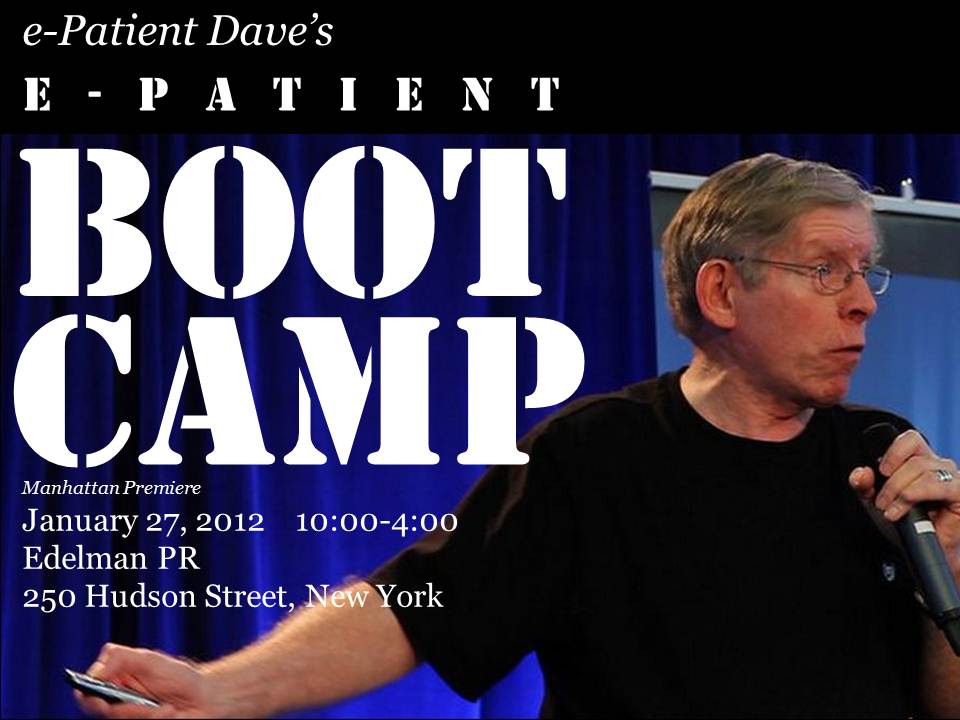
> Boot Camp! <

Lecturing at FutureMed, at Ray Kurzweil's Singularity University, NASA Ames Research Center, Mountain View

Patient engagement is reshaping healthcare. Learn how. Learn why. Learn what to do.

First American edition: January 27, New York. Agenda and logistics below. Registration is now open on EventBrite.

e-Patients are equipped, enabled, empowered, and engaged in their care. They form empowered care partnerships with enlightened clinicians, sharing the load as well as the steering wheel. And they connect with each other, sharing knowledge and experiences in ways that were never before possible.

This is changing healthcare – reshaping what’s possible.

Learn how, learn why, and learn what to do, in this in-depth training from e-Patient Dave, the best-known spokesman of patient engagement. Save the date – registration should open the week of December 19.

Preliminary Agenda:

N.B.: Actual details are in development. An expert panel is expected, and hands-on web exercises; the following is a draft.

The e-Patient Boot Camp is the first-ever compilation of my keynotes and panel presentations from the past two years, speaking to dozens of audiences in many sectors: hospitals, care plans, small group practices, governments, government contractors, Federal policy meetings, health IT – everything from the Quantified Self to the Israel Internet Society, from healthcare improvement to the Duke Institute on Care at the End of Life.  Get thousands of dollars of conference content in a single day, plus hands-on:

  • Session 1: History of Patient Engagement, and a Case Study
    • Medical and cultural precursors; pioneers of e-patient behavior
    • Case study: my near-fatal cancer, and how the internet supplemented the excellent medical and surgical care I received
    • Pay it forward: my first blog
  • Session 2: “e-Patients: Empowered, Engaged, Equipped, Enabled”
    • Discovering the e-patient movement and “the e-Patient White Paper”
    • How can it be that patients – without medical degrees – can genuinely bring value to the table??
    • Health on the internet: harnessing the value, preventing the risks
    • Doctors online – shifting the balance of online quality
  • Session 3: “Give Us Our Data” – reshaping care through health IT
    • The validity and usefulness of patient access to medical records
    • Patient engagement becomes Federal policy: the US government’s Meaningful Use rules
    • Data quality in our medical records: my experience
    • “Google Earth for my body”
    • Innovation in the era of Open Data; the Startup Health initiative
  • Session 4: The future of “e”: other e-patients and reshaping the care dynamic
    • We are many: other e-patients and their stories
    • e-Patients and clinical trials
    • Shared Decision Making: Engaged patients at the decision table
    • A glimpse of the future: What Watson may mean for e-patients and their clinicians
  • Plus: hands-on exercises. Bring your own browser – possible examples:
    • Researching disease information – filtering the gold from the garbage
    • Patient communities
    • Group discussions

Curriculum can be customized for future events; see below.

Who should attend

People who want to understand how e-patients are reshaping what’s possible in healthcare. Health workers, government policy people, innovators, investors, anyone.

And patients, and their “e-patient proxies”: friends, relatives, community health workers.

Your instructor

“e-Patient Dave” is a dynamic, highly rated international keynote speaker, author, and advisor on government policy. The Boston Globe called him “a recognized online champion of participatory medicine,” Health Leaders featured him in its “Patient of the Future” cover story and named him (and his physician, Dr. Danny Sands) to their “Twenty People Making Healthcare Better.” See his bio, his Wikipedia page, testimonials, honors, videos of past speeches, and his TEDx talk (with standing ovation!) in the Netherlands this April.

Front cover

Your schwag

Registrants who pay in advance will also receive:

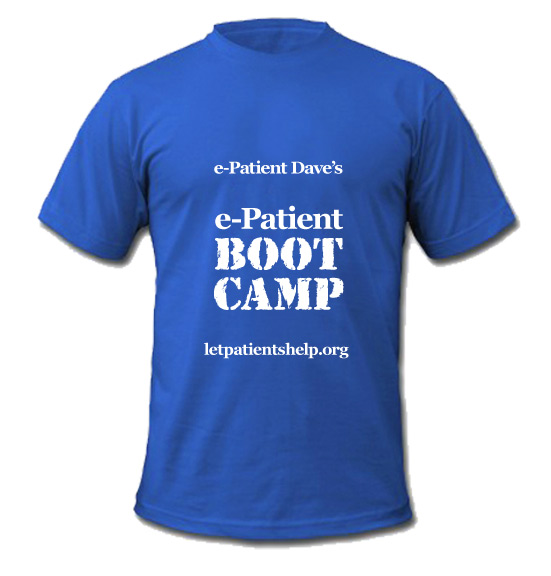
  • A Boot Camp t-shirt
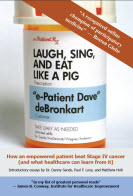
  • Dave’s first book, Laugh, Sing, and Eat Like a Pig: How an empowered patient beat Stage IV cancer (and what healthcare can learn from it.) Get it signed on-site!

Registration and Logistics

  • Where: Edelman, 250 Hudson St, New York, N.Y. (Lower Manhattan)
  • When: 10:00 a.m. to 4:00 p.m., Friday, January 27, 2012.
  • Price:
  • $499.
  • Patients just $10, space allowing. Must apply for this status, on the ticket purchase page.
  • 50% off for health professionals who bring one of their patients and promise to practice what we’ll preach.
  • Registration is now open on EventBrite.
  • No recordings, please.

    Future Boot Camps

    We seek partnerships with regional healthcare thought leaders, around  to c0-brand, co-promote, and produce this event, adjacent to major conferences or as an independent event, public or private. See the contact page.

    Optional modules for custom boot camps:

    The e-Patient Boot Camp is in its early days, crafted out of two years of speaking engagements. Additional content is in development for delivery in private or public sessions. Examples:

    • Deep dive on Meaningful Use – regulations and reality from the patient perspective
    • Challenges of diagnosis and how e-patients can help
    • Projects already underway with open health data: the VA’s Blue Button; the Direct Project
    • Healthcare: the only industry where quality’s not defined by the customer.
      • Implications for transformation efforts and quality improvement.
    • Deep dive on shared medical decision making and practice variation: realities, problems, impact on costs and happiness
    • Safety and medical errors: what you need to know and what to do about it
    • Researching: Evaluating what you read, in the mass media, online, and in medical journals
    • Patient communities: finding them, starting them
    • Social media and healthcare: finding what you need, sharing what you have

    Additional modules about inspiration, life, and dealing with disease, not specific to patient engagement:

    • The power of  attitude in the face of obstacles
    • Facing death: my experience as a patient confronting the end of life.
      • Note: Your time will come; your parents’ time will come.
      • Patient & family engagement in end of life decisions
    • Attitude in the face of illness: evidence, and being powerful in the absence of evidence
    • Disease happens while life is happening: getting by, making do, making the most of it – how to “laugh, sing, and eat like a pig” no matter what life hands you.

    As I’ve said before, having faced the end, and survived, I’m using my “free replay” to change the world. Let me know how we can work together.

    Introduction

    June 27, 2010

    My book Laugh, Sing, and Eat Like a Pig: How an Empowered Patient Beat Stage IV Cancer (and what healthcare can learn from it) is nearing completion: it’ll be on Amazon in a week or two.

    We who’ve worked on it hope it will provoke thought about how healthcare is changing because of what e-patients can contribute, empowered as individuals and enabled by the internet. To start that process, we’re publishing the introduction.

    Three friends and mentors generously offered introductory essays.
    These essays they have little to do with my story, and everything to do with how e-patients can help heal healthcare:

    • Part 1, by Dr. Danny Sands: Putting Information—and Knowledge—in Patients’ Hands
    • Part 2, by Paul Levy: Yes, Patients Can Help Their Doctors
    • Part 3, by Matthew Holt: Changing Relationships and Changing Technology

    Other resources: the book’s home page; previews of advance praise from reviewers


    Putting Information—
    and Knowledge—in Patients’ Hands

    Photo courtesy of Beth Israel Deaconess Medical Center

    By Daniel Z. Sands, MD, MPH

    My primary care physician since 2003.
    The first doctor to support me in being empowered and engaged

    “Knowledge is Power,” wrote Francis Bacon. Nowhere is that more true than in healthcare. Knowledge allows us to care for and advocate for our health most effectively. This is especially true in chronic and serious illness.

    It is said that information is a prerequisite for knowledge (and knowledge, combined with insight and experience, can lead to wisdom), and yet physicians often avoid sharing information with patients. This information asymmetry causes patients to be deprived of the tools they need to care for themselves.

    Why the reason for this asymmetry? [Read more…]

    Videos

    My Second Career –
    from High Tech Marketing to Healthcare Evangelist
     

    Latest additions are at the Blog Posts heading below.
    _______

    Having survived a medical “death sentence” with the help of brilliant clinicians and treatments, I’m passionate about healthcare – its problems and its potential. Combining that with my experience as a business analyst and conference presenter, I’ve become an avid speaker on all aspects of healthcare transformation, consumerism, digital health (internet-driven “Health 2.0”) and patient experience and engagement. Below are recordings of some of the talks I’ve delivered. From different angles, each weaves in participatory medicine, high-tech thinking in healthcare, social media, patient engagement – and the joy of being alive.

    TED Talk: “Let Patients Help”

    Over 700,000 subtitles in 27 languages.

    Thanks to all the Dutch visionaries who created this extraordinary TEDx Maastricht event on the future of health, especially the team of Lucien Engelen, who had the vision to make a patient the first speaker named, when the event was first announced.  He saw what others are seeing today – the chant at the end of the video: Let Patients Help heal healthcare!

    Index of archived presentations

    The new era: empowerment and autonomy through AI

    Eleven years after that TED Talk, in 2022 generative AI arrived on the scene and changed everything. (I don’t think that’s an overstatement, do you?) Meanwhile, the world has continued to learn how empowerment works. Two recent talks:

    • Returning to the scene of that TED Talk, Maastricht, half a generation later: “Empowerment happens by removing constraints” (May 2024, 19 minutes +Q&A).
    • “The Dawn of Patient Autonomy” – opening keynote at Frontier Health, Berlin, October 2024

    Blog posts with videos:

      • NEHIMSS 2019: teaching Patient-Clinical Partnership with role play – and a song, with Dr. Danny Sands (June 2019)
      • HL7 FHIR DevDays 2018: From ‘Let Patients Help’ to ‘Get Out of My Way’: why some patients want ALL their data now, (Nov. 2018)
      • Informal interview with @Chimoose (Greg Matthews) about the business value of the patient’s voice, Oct. 2014 (posted January)
      • From MedicineX 2013: Social Media is a Pipeline of Patient Needs and Perspectives (18 minutes)
      • Digital Health Days, Stockholm (“the Land of Nobel”) (August 2014):
        • 20 Minute Opening Keynote, tying our movement to the history of the Nobel Prize in Medicine
        • 9 minute hallway interview – my views on additional topics at the event, especially Quantified Self, Susannah Fox’s findings on Twitter vs Facebook
        • The closing panel (50 minutes total)
          • My first four minutes start at 18:30, about SPM and Regina Holliday’s story via my “Walking Gallery” jacket
          • Another five minutes start at 33:07, about the potential and the limits of “Gimme My Damn Data”
        • “Dagens Patient” workshop at Karolinska Institute (30 minutes)
      • My Call to Action at the Blue Button Plus Developer Conference, NY (event was July 2013, video was released Feb 2014)
      • AMIA Keynote (standing ovation), Nov. 2013
      • One of my best speeches in years: Keynote Presentation at NEHI’s 2013 Innovation Conference: Patient Engagement 360
      • National Council of State Boards of Nursing, August 2013 (47 minutes)
      • ONC Consumer health IT event, Sept 2013 (14 minutes)
      • SAS Institute, May 2013 (56 minutes)
      • “My Health Counts: e-Patients” (WNED-TV program, 27 minutes; my part’s about 12 minutes)
      • “I want the best to thrive” – keynote to hospital boards and executives, St. Luke’s, Boise ID, Feb 2013 (65 minutes)
      • “Information at the point where it’s needed can save a life” – Joseph H. Kanter Family Foundation (36 minute dinner speech)
    • High Tech: “The Quantified Patient” (The Quantified Self, December 2009; 14:43)
    • Academic / Medical:
      • Doctors and Patients on the Same Page: Welcome to the Age of Participatory Medicine/Open General Session: SIIM (Society for Imaging Informatics in Medicine) (June 2018)
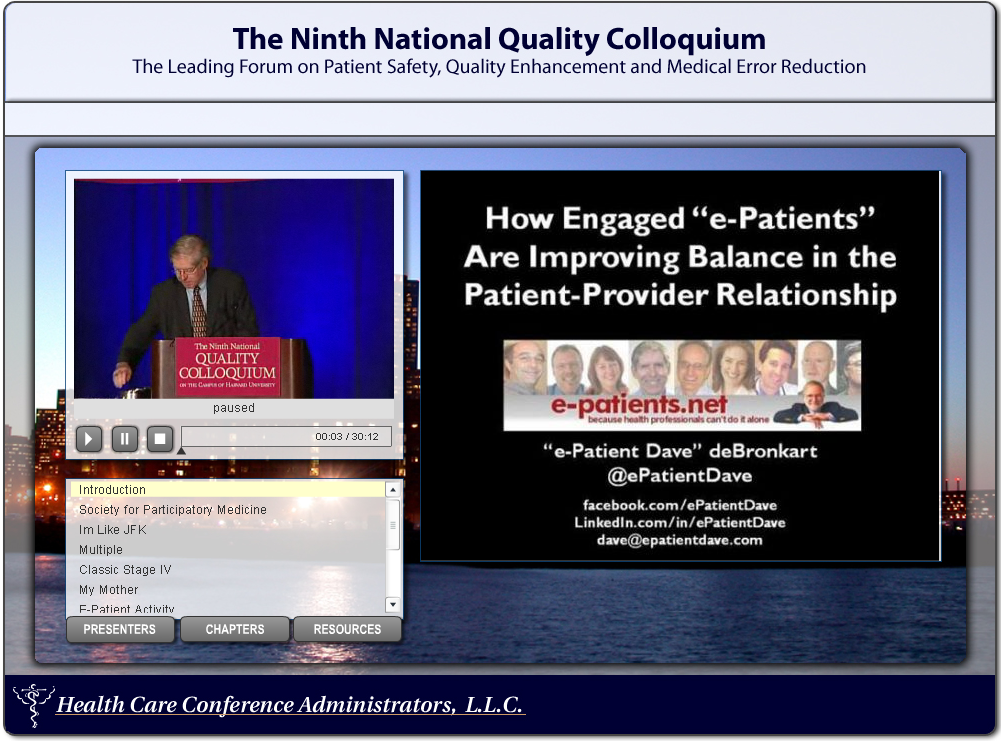
      • “How Engaged e-Patients are Improving Balance in the Patient-Provider Relationship” (Plenary address at Ninth Quality Colloquium, Harvard, August 2010; 30:12)
      • “Gimme My Damn Data” (Opening keynote at Medicine 2.0 Congress, September 2009; 40:00)
      • “How Patient-Provider Engagement Can Transform Healthcare” with Dr. Danny Sands (Special Interest Keynote session A1 at IHI Forum, December 2010; 73:13
    • Business / Social Media:
      • “Are You Ready for the e-Patient?” (Swedish Medical Center, October 2010)
      • “Engage Authentically” (e-Patient Connections, October 2009; 17:50)
    • Policy / Health IT:
      • “Give Us Our Data” (NeHC board meeting, June 2009; 24:06)
      • “Over My Dead Body” (AHRQ IT contractors, June 2010; 1 hour)
    • Impromptu interviews:
      • Reach MD at Alliance for Continuing Education in the Healthcare Professions in Orlando, Florida, Nov. 2017
      • Podcast about clinical trials: Clinical Trials Guru (Sept 2010; 25:59)
      • Dr. Anonymous interview at HIMSS conference (health IT), Atlanta, March 2010

    High Tech

    Quantified Self, at Wired headquarters: “The Quantified Patient”
    December 7, 2009, San Francisco.

    “Quantified Self” is an eclectic group that could only exist in the Bay Area – infogeeks who are into measuring just about any aspect of their lives. QS evenings consist of an hour of elbow-rubbing then a series of short, rapid-fire talks; there’s no time to get bored, and you have to get to the point. The challenge here was to deliver a 45 minute talk in 15 minutes, covering all the bases coherently without the usual depth.
    Back to top

    Business / Social Media

    1. Swedish Medical Center: “Are You Ready for the e-Patient?”
    October 2010, Seattle.

    Swedish, as it’s known, is not known enough. An innovative center of excellence for many years, Swedish celebrated its 100th birthday with a two day conference – and befitting their leadership, they started with a half day social media conference. Earlier in the year, Communications Director Melissa Tizon scored a coup by snapping up social media goddess Dana M. Lewis. Together they put together a terrific line-up of social media stars, talking about all aspects of social media in healthcare. They asked me open the day, challenging employees and visitors to ask whether they’re ready to make the most of working with today’s engaged patients.

    (A confession: on this speech I muffed the ending. As you’ll see, uncharacteristically for Seattle, the sun came out and shone straight in my eyes. I usually want a more powerful ending. This one ended where it ended. :–))

    2. e-Patient Connections 2009: “Authentic Value: Being Known in e-Patient Communities.”
    October 2009, Philadelphia.

    The setting was a pharma industry marketing conference, the first to be focused on how industry can engage with activated patients, both to empower patients to have a more active role in their care and, in exchange, so vendors can leverage the sometimes enormous contributions patients can make to the industry’s knowledge. The challenge, of course, is that due to many stories of manipulated data etc etc, many engaged patients don’t trust pharma. I drew on my experience in business and in social media to deliver my message: Engage Authentically.

    Back to top

    Policy / Health IT


    1. National eHealth Collaborative board meeting: “Give Us Our Data
    June 24, 2009, Washington.
    NeHC is an inspiring collaboration of non-profits in Washington devoted to improving healthcare through technology. This meeting occurred during the pivotal summer discussions about defining the “meaningful use” of health IT that’s required in order to qualify for the incentive payments offered in the ARRA/HITECH stimulus bill of 2009. I was invited to speak on the vital issue of giving patients access to their data.

    This was an impromptu talk, which I put together while listening to the previous speakers. It’s an informal recording, not including my slides; it shows my speaking style but not my use of visual aids.

    Back to top

    2. Keynote to AHRQ’s IT Grantees and Contractors
    June 10, 2010

    This was the first time I was given a full hour to go deep into my points – not just touch relatively lightly on patient engagement, but dig into why it matters.  The depth matters – that’s why I developed the e-Patient Boot Camp – a full-day workshop. Thank you to Jon White at AHRQ for his partnership both in making this possible and in discussing what would be of value to this audience.

    Click below to play the slides. For audio and video, click to download this tiny file, which plays it on AHRQ’s archive. Updated 8/22/15.

    About AHRQ: The Agency for Healthcare Research & Quality is a terrific Federal agency that administers grants and contracts for health-related projects, including health IT. This was a high quality audience of smart people who manage significant projects.

    About the title: Just before this meeting a rumor was circulating that an executive at a medical records company had said “Over my dead body.” The exec was referring to the idea that these systems would be required to be usable by the clinicians who care for us. I was aghast; a December lecture by Ross Koppel had detailed how bad some of the systems were, and believe me, if hospital staff are caring for my loved one, I want them to have a good system, not one that screws up as badly as Koppel describes. So I threw that line in the industry’s face, using it as my title – and connecting it to why this matters to patients.

    We must, must, must stop thinking about systems primarily in technicians’ terms. We must remember that the purpose of healthcare is to deliver care, and tools must support the workers who do that.

    Back to top

    Academic / Medical

    1. “How Engaged e-Patients are Improving Balance in the Patient-Provider Relationship”
    (Plenary address at Ninth Quality Colloqium, Harvard, August 2010) Click to visit the video, with slides, on their site. Thanks to the conference for making this video free to the public!

    Back to top

    2. Opening keynote at Medicine 2.0 Congress: “Gimme My Damn Data”
    September 17, 2009, Toronto.

    Medicine 2.0 is an academic congress, the only event I’ve attended where every single session was of interest to me in helping learn how Web 2.0 is changing healthcare by newly empowering everyone – not just patients but physicians and researchers. I was humbled to be invited by Dr. Gunther Eysenbach to deliver the opening keynote.

    In this expanded 40 minute format I was able to cover not just the cancer story but a broader review of what “e-patient” is about, the opportunity to transform healthcare through participatory medicine and through IT, and the sorry state of affairs we face today regarding patients’ access to their data. (Whose data is it, anyway?) Gimme my damn data, so I can help! The opening slide says September 18 – I got the date wrong!

    Part 1:

    Part 2:

    Part 3:

    Part 4:


    3. Special interest keynote at Institute for Health Improvement’s 2010 Forum: “How Patient-Provider Engagement Can Transform Healthcare”
    December 4, 2010, Orlando.

    The Institute for Healthcare Improvement may be the best organization anywhere in the work they do to change the world of healthcare. This year at their annual Forum in Orlando, they did two extraordinary patient-oriented things: they invited fifty patients to attend at no cost, and they put a patient story at the top of the agenda, right after the opening keynote by IHI president Maureen Bisognano.

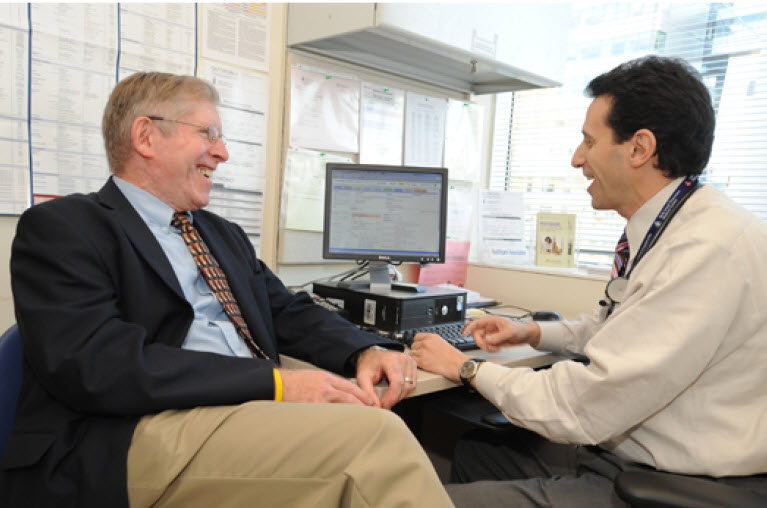
    Dr. Danny Sands and I told our story from both physician and patient perspectives. Thanks to the Institute for Healthcare Improvement for making this video freely available to the public!

    Impromptu interviews:

    1. Vidcast about clinical trials: Clinical Trials Guru (Sept 2010; 25:59)

    These guys are a hoot: with virtually no budget and freely admitting they’re making it up, they’re forging ahead. They do these informal interviews using Ustream, which is not intended for this sort of thing, but it does archive the video, which they can then post like this. They’re advancing their cause using freely available tools, and here we are: they’re reaching you. That’s healthcare social media – one tiny example.

    Here’s their archive of past Ustream vidcasts and their clinical trials search page, which pulls from the government website ClinicalTrials.gov. For this series all they do is switch on Ustream (a free videocasting service) and get on the phone with someone. How simple is that? It’s then instantly available for publishing on the web. Here’s our informal, unrehearsed talk:

    2. Impromptu interview with “Doctor Anonymous” (March 2010)

    He and the famous Doctor Val, both of the Get Better Health blog, were doing scheduled interviews during the huge HIMSS health IT conference in Atlanta. A scheduled guest no-showed, so Val nabbed me in the hall and pulled me in. There was no plan, but we ended up talking about “What the heck is this e-patient stuff, anyway?? Is it about patients thinking they’re smarter than doctors??” No, it’s not – it’s about being good partners with supportive physicians. The interview worked out pretty well – now I’m a guest blogger on their blog!

    For Patients

    Looking for a patient community? The world doesn’t yet have a great searchable database, but some of us have started lists. Here’s my start – contribute anything more you find!

    DrSpockAn engaged patient plays an active role in his or her care. Or, as e-patients.net founder “Doc Tom” Ferguson said, “e-Patients are Empowered, Engaged, Equipped and Enabled.”

    We who’ve become e-patients don’t wait for our providers to tell us everything; we get it in gear, we ask questions, we do what we can to help.

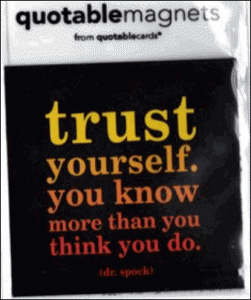
    Don’t think you’re qualified? Consider the advice on the magnet at right:

    Trust yourself.
    You know more
    than you think you do.

    Radical new advice? No, it’s the opening line of Dr. Spock’s Baby and Child Care, first published sixty years ago, in 1946.

    Convinced, but not sure where to start? As time goes by I hope to develop tutorial materials. If you have a project, or requests or ideas, contact me. It starts with this:
    .

    Understanding what we read about health information

    To take Dr. Spock’s advice one step further, you may not be a health professional, but you’re probably capable of understanding a lot more than you think. I’m committed to gathering and sharing as much as I can to help with that.

    As you educate yourself, either through medical publications or through the mass media, it’s important to know that in both cases, some of what gets published is high quality but a lot is not, and you can detect the difference.

    • A piece may be written from a biased perspective (even plain old paid endorsements)
    • It may be fair but written imprecisely,
    • It may have been written brilliantly but edited in a way that leaves the wrong impression. (Some editors are well trained but make mistakes; others aren’t scientifically trained.

    In any of those cases, the words that reach your eyes may lead you astray. And when your health is at stake, the last thing you need is bad advice from a channel you thought you could trust.
    .

    e-Patient Skill 1: Wise up about health news.

    A great resource is Health News Review. healthnewsreviewManaged by Gary Schwitzer, a journalist with terrific medical experience, the site reviews health news coverage with clear comments that make it easy for you and me to learn how to read carefully and spot important missing information.

    Modeled on Media Doctor Australia, which spawned Media Doctor Canada, Health News Review is also a great learning resource for writers, editors (and even bloggers!) who want to improve their science writing.
    .

    e-Patient Skill 2: Wise up about the statistics you read. Learn how to interpret them.

    When we’re in a crisis it can be hard to hear “We just don’t know what your odds are.” That can lead us to latch onto any available number, but it may or may not be useful information.

    Statistics can be misleading. Sometimes it’s intentional (the old “lies, damned lies, and statistics” thing), but e-patients also need to wise up about interpreting statistics that are published with the best intentions.

    See, the whole purpose of statistics is to give us useful insights into the unknown, by looking at things that happened in the past. It can work, if you have no better information and if the current situation is a good match for how and when the study was done. Those are the factors you need to look for.

    In my own case, I read that the median survival time for people in my condition was 24 weeks (5-1/2 months). Does this mean “they gave me 24 weeks to live”? No.

    • It means that in whatever study they reported, the middle patient died in 24 weeks.  It tells us nothing about any other patient.  They might all have died in 24 weeks, or everyone beyond the middle patient might still be alive today. You can’t tell, from the information given.
    • The next problem was that although the study was the most recent published data, the circumstances were already obsolete. It takes years to design a study, start it, and watch people get treatment and then live or die. This is especially challenging when treatments are rapidly evolving: the most useful information may not have been published yet. And you may be able to help find it.

    As yet another dimension, remember that statistics apply to populations, not individuals. Want proof? Consider this: the average person has one ovary. That’s absolutely true – but it gives you no useful information about any individual.

    Here are some of my past posts on statistics:

    • Making sense of health statistics – discusses a terrific 40-page article about how even writers, policymakers and even physicians(!) often misconstrue published numbers. The article’s long-ish, the post isn’t.
    • Evidence-based medicine (“EBM”) – a topic every e-patient needs to understand, for what it is and what it isn’t. EBM is an important response to research that showed wide variation in how often various procedures were done. (Hysterectomies were one example that particularly turned my stomach.) Today the gold standard is to make care decisions based on evidence. This is good but it has its limitations.

    And I’d be remiss if I didn’t cite the granddaddy of all patient-empowerment stats articles, The Median Isn’t The Message, by famed scientist Stephen J. Gould. Gould outlived the “median survival time” for his mesothelioma (eight months) by 20 years, eventually dying of something else – in other words, the disease didn’t kill him at all.

    Personally, I’ve outlived my median survival by a factor of 5.8. So far.

    Get educated, get engaged, get empowered. Get E.

    Recent coverage

    Dave is a recognized international source for informed perspectives on all aspects of participatory medicine and patient engagement. Reach him via the contact page.

    2024

    • Sept 11: Dr. Chatbot Will See You Now, New York Times

    2021

    • Sept 14: Open Notes Shines Light on Errors in Patient Medical Records. MedPage Today
    • April 5: New law requires health care organizations give patients access to their records digitally. WINK News, Fort Myers

    2020 (partial)

    • December 30, Healthcare IT News: ‘e-Patient Dave’ on why patients need access to medical images
    • October 19, Fierce Healthcare: Industry Voices—These 4 words could transform health. Let’s start using them
    • January 31, Pulse+IT: Opioids, Kickbacks, and EMRs.
    • January 29, Healthcare IT News: Epic continues campaign for changes to forthcoming ONC info blocking rules.
    • January 23, UCSF radiology department: UCSF Patients Can Now Access Medical Images on MyChart (citing my SIIM keynote)

    2019

    • December 12, Agility: Top U.S. Social Media Influencers in Healthcare
    • November 19, Yale Podcast Network: Becoming an e-Patient
    • November 20, Kaiser Health News; Startup Seeks To Hold Doctors, Hospitals Accountable On Patient Record Requests; California Healthline; Hartford Courant; Chicago Tribune; Benefits Pro; Orange County Register, The Keene Sentinel
    • October 18, Politico Morning eHealth newsletter: eHealth tweet of the day
    • October 7, Healthcare IT News: Society for Participatory Medicine touts 10 years of patient-centered wins
    • September 23, CBS News: How to read a medical bill or explanation of benefits
    • August 30, Urology Times: How to improve patients’ access to their health information.
    • May 20, Dimensional INSIGHT: Takeaways from New England HIMSS: The Human Side of Healthcare Technology
    • May 20, Health IT TODAY: Re-enactments, Singing and Dancing the Highlight of NEHIMSS Annual Spring Conference
    • May 17, Health IT Connect: Partnering for your health
    • May 10, Cision: NCPDP Announces Highlights from Its 2019 Annual Conference, Dare to Disrupt
    • April 4, THE EPOCH TIMES: Check Your Medical Records For Dangerous Errors
    • April 2, HIT Consultant: 6 Patient Influencers Redefining The Healthcare Landscape
    • February 18, PharmExec.com: DIA Europe: Patients Get Their Say. Now for the Doctors?

    2018

    • December 17, Health News Review: Reflections on a 45-year career and 13 years leading HealthNewsReview.org
    • November 21, ABC News, Kaiser Health News: Check your medical records for dangerous errors, experts warn
    • November 19, Philips Future Health Index 2018: Telehealth: Delivering value across institutional and geographical borders
    • November 19, Patient Voices Network: QI Connect with e-Patient Dave
    • November 5, WEGO Health: Has the “Gimme My Damn Data” movement reached a tipping point?
    • October 17, Associated Press: DIA Drives Debates and Solutions at the Crossroads of Healthcare.
    • October 9, NBC News: Undercover study highlights patients’ struggle with medical records.
    • October 5, EurekAlert!: Yale University. American hospitals make it too hard for patients to access medical records
    • September 26, Digital Journal: ‘e-Patient Dave’ to Speak at 9th Annual RISE Star Ratings Master Class in San Diego
    • August 30, Health Tech Magazine: 30 Must-Read Health Tech IT Blogs 2018
    • July 10, The Daily Times: Solutionreach Collaborates with Patient Advocate Voices to Share the Patient Perspective
    • June 26, CuerpoMente: Participatory medicine: when the patient is the expert
    • June 26, WBUR 90.9 Boston: Dr. Warner Slack, Electronic Medical Records Pioneer And Champion of ‘Patient Power’, Dies
    • June 13, WTNH News 8 Hartford: The Better Health Conference: Helping to Change Healthcare As We Know It
    • June 12, DOTmed: How can women close the ‘diversity gap’ in imaging informatics?
    • June 1, DOTmed: e-Patient Dave opens SIIM meeting focused on patient engagement and big data
    • June 1, AuntMinnie: SIIM: Patients should have access to imaging studies
    • April 10, HealthNewsReview: A cancer doctor speaks out: How premature hype about experimental drugs fail patients
    • March 8, Forbes: Alex Azar, Trump’s New HHS Secretary, Makes Surprisingly Bold Policy Speech 
    • February 27, STAT: I have brain cancer.  Drug companies and med schools should be compensating me for my expertise
    • February 16, Medium: Self-care should start with managing your personal digital identity and health information
    • January 25, HealthExec: Apple’s health records system a ‘nice start’ but offers limited data to patients
    • January 24, The San Diego Union-Tribune: UCSD among 12 nationwide to pilot Apple Inc. new medical records system
    • January 14, USA Today: Health care deals could make you healthier but may not save you money
    • January 12, WBUR: Dave and Danny, E-Patient and Doctor, On The Rise of ‘Participatory Medicine’
    • January 11, WBUR: A Doctor and Patient on Participatory Medicine.

    2017

    • December 18, Personal Health News: How Being an Empowered Patient Helped Save This Life 
    • November 10, The Royal Australian College of General Practitioners (RACGP): e-Patient Dave: Maximising the patient as a resource
    • November 10, Scoop News: Fingermark’s ‘Florence’ Focuses  on Patient Experience
    • November 2, RadioNZ: e-Patient Dave: ‘Gimme my damn data!’
    • October 26, Genome: Cancer Survivor Urges Patients To Be Proactive
    • October 6, Scoop Independent News, New Zealand: Patients & Doctors Should be Partners in Healthcare
    • September, AARP: How to Find a Great Doctor 
    • July 27, NOLA: MRI for $1,005 or $464: Hit to your wallet depends on your insurer
    • May 30, U.S. News & World Report: 10 Lessons From Empowered Patients
    • May 23, NOLA: For some Louisiana health insurers, explanation of benefits are anything but
    • May 18, Future Health Index: Future Health Index 2017 report
    • May 2, That’s Unusual podcast: e-Patient Dave on Patient Activism, Participatory Medicine, and the Science of Engagement. 
    • April 26, NEJM: Whose Data Are They Anyway? Can a Patient Perspective Advance the Data-Sharing Debate?
    • April 14, Bonnie Schooler Communications: Healthcare Professionals are you ready for e-Patients?
    • April 5, Fox 8 New Orleans: Zurik: ‘Cracking the Code’ of medical procedure pricing
    • March 24, next avenue: Are You Getting Medical Treatment You Don’t Need?
    • March 20, Health News Review: No Surprise: Repatha reality is messier than initial reports suggested
    • January 31, Forbes: Putting Me Into the Cancer Moonshot

    2016

    • December 20, Healthcare IT News: The promise of patient engagement
    • December 14, MedCity News: This week in patient engagement: Gulf persists between patients and officials
    • December 9, MedCity News: HealthSparq seeks ‘idiotic’ stories with #WhatTheHealthCare campaign
    • November 23, MedCity News: This week in patient engagement: Two vocal advocates share their tribulations
    • November 20, The News: New Glasgow woman, entrepreneur, receives honour of excellence
    • November 14, prweb: Improving Access To Clinical Trials: American Kidney Fund Adds User-Friendly Search Capability and Information to Kidneyfund.org
    • November 9, Software Advice: Patient Expectations for Modern Medical Practices (Pt. 1): Patient Outreach
    • October 26, MedCity News: ENGAGE: 5 takeaways from MedCity’s patient engagement conference
    • October 20, MedCity News: ‘e-Patient Dave’ says a patient ‘revolution’ is already underway
    • September 25, The Wall Street Journal: Technology and Health Care: The View From HHS
    • September 14, Healthcare IT News: OpenNotes announces advisory board to guide growth on patient engagement efforts
    • September, 8, Pacific Standard: Fighting Back Against Parkinson’s
    • September, 5, Digital Trends: Tech wrecked our bodies, but next it will make us healthier than ever
    • August 26, Detroit News: Hospital records kept from public
    • August 20, BuzzFeed News: This Guy Swallowed Parasitic Worms On Purpose – Then Became a Published Scientist
    • August 17, IXDS: Getting to know Health 2.0
    • August 10, STAT News: NEJM editorial doubles down on resistance to data sharing
    • August 1, Klick: EPATIENT POWER!
    • July 24, Glass Hospital: e-Patient Dave
    • July 20, Nordic Life Science News: Teaching patients and doctors to work together
    • July 19, U.S.News: In Research World, Long-Term Injury Care Hard to Come By
    • July 15, Clinical Leader: Clinical News Roundup: Animal Testing To Transform Cancer Treatment In Humans
    • July 14, JDRF: JDRF and TrialReach Launch a New, No Cost Clinical Trial Matching Tool to Solve Critical Challenges in Diabetes Research
    • June 29, prweb: White House Announces TrialReach to support Cancer Moonshot Initiative
    • June 2, Chronicality: Trust Your Gut: When to Seek a Second Opinion.
    • June 2, La Vanguardia, Barcelona: “I learn what I can on Google, and share it with my doctor”: Aprenc tot el que puc a Google i ho comparteixo amb el meu metge ) (in Catalan); El incómodo enfermo que consulta internet (Spanish)
    • April 12, The New York Times: Shopping for Health Care: A Fledgling Craft
    • March 22, The Huffington Post: An Alert, Well-Hydrated Artist in No Acute Distress-Episode Sixteen: The Patient Will See You Now
    • March 15, Healthcare Packaging: Trends from the 2016 PDA Annual Meeting
    • February 8, MedCity News: UK spending billions on health IT, remote patient monitoring
    • February 4, Health Leaders Media: Unwise Medical Choices Stubbornly Defy Eradication
    • January 13, Health Leaders Media: 3 Ways Up Your Content Marketing Game

    2015

    • December 30, co-designing digital health & wellbeing:  People centred participation – thinking forward to #kfdigital16 
    • December 5, MedPage Today: Understanding Healthcare Costs: Meaningful Steps Going Forward
    • December 4, MedPage Today: Understanding Healthcare Costs: Conversations With Payers
    • December 3, MedPage Today: Understanding Healthcare Costs: Patients Talk $$ With Providers
    • November 30, Washington Post: Here’s how patients can take a larger part in their own care
    • November 3, MedCity News: Morning Read: MedAssets going private, AmSurg withdraws TeamHealth bid
    • September 30, Forbes: 6 Ways to Pay Less for Healthcare
    • September 29, CMIO: AMA’s town hall calls for MU pause, interoperability fix
    • September 24, SCOPE, Stanford Medicine: Day one of Medicine X Ι ED: Understanding and equipping today’s medical learner
    • September 21, USA Today: Health care prices vary wildly: What can you do?
    • VIDEO: September 18, KTBY (Channel 4): Alaska Nurse Practitioner Conference
    • September 18, KATN (Anchorage Channel 2, ABC): Being Your Own Health Advocate
    • VIDEO: September 16, KTBY (Anchorage Channel 4, Fox):  Commonwealth North breakfast seminar
    • September 13, The [Louisville] Courier Journal: Wildly varied health costs a national mystery
    • September 9, Southern California Public Radio: When is it OK to record your doctor’s orders?
    • August 30, Skipr (Dutch): Vermoeidheids-app wint health-hackathon REshape  (“Fatigue app wins health-hackathon REshape”)
    • August 18, MedCity News: E-Patient Dave: Time to open the medical records spigot
    • August 11, Ouderenjournaal (Dutch): Drie dagen lang in een creatieve snelkookpan (“Three days in a creative pressure cooker”), about the Hacking Healthcare event in the Netherlands where I was a judge.
    • August 5, Forbes: Medicine is Going Through A Revolution — With Doctors’ Help
    • August 4, The Center for Public Integrity: Obamacare research institute plans to spend $3.5 billion, but critics question its worth
    • July 20, British Journal of Healthcare Computing: Vox Pop: ‘It’s possible today for patients to truly contribute value’
    • July 17, Computer Weekly (UK): Stop telling patients not to Google – one man’s quest for joined-up healthcare. Article about last month’s Joined-Up Health event at Intersystems in London
    • July 14, Health News Review: Susannah Fox on the hunt to democratize access to patient data
    • July 13, Glass Hospital: An Amazing Story of Patient Engagement
    • July 10, The Boston Globe: Looking to diagnose your ailments online? be careful
    • July 2, MedCity News: Get My Health Data campaign launches in time for ‘Data Independence Day’
    • July 2, Huffpost: You Don’t Look Like You Have Epilepsy
    • June 19, Nuviun: 7 definitions of 21st century patients, for better or worse
    • June 12, The Chronicle: Popping the question – how and why to engage patients in health care
    • June: National Board of Medical Examiners:  Annual Report (PDF) (pp 11, 13, 82) – coverage of my plenary at their 100th Annual Meeting; member of their Patient-Centered Assessment Task Force
    • May issue of ImproveDx: Newsletter of the Society to Improve Diagnosis in Medicine. In “Improving Communication of Test Results in a Changing World” by Susan Carr.
    • May 30, IntrepidNow: #TalkHIT with CTG – Dave deBronkart (ePatient Dave), The Original ePatient Advocate
    • May 28, AstraZeneca Health Connections: E-Patient Dave: “The Internet Brings Patients Together”
    • May 14, Mayo Clinic “In the Loop” “‘Healing Words’ Program Creates Space for Patients to Reflect and Clarify” about my interview on facing death with hope
    • May 11, KQED: Patient Advocates Fight for Access to Medical Data: ‘It’s a Matter of Life and Death’
    • May 7, MaRS: A Fireside Chat with e-Patient Dave and Lucien Engelen
    • May 7, NHPR (New Hampshire Public Radio): Tech Tools Aim To Drive Down Health Costs In N.H.
    • April 27, Washington Post: How is the doctor-patient relationship changing? It’s going electronic.
    • April 19, #TalkHITwithCTG audio interview from HIMSS: Dave deBronkart (ePatientDave), The Original e-Patient Advocate. Includes transcript, and link to the other e-patient interview at that event, featuring Regina Holliday, Carly Medosch, Melanie Peron, Amanda Greene and Tami Rich
    • April 11, MHA Degree.org: Top 50 Healthcare Influencers to Follow on Twitter
    • March 23, Medscape Medical News (subscription required): Patient-Powered Care Drives New Relationship With Physicians
    • March 13, KQED Science: Startups, Entrepreneurs Try to Solve Medical Records Debacle
    • January 30, Boothbay Register: New Empowered Patient series launches Feb. 9
    • January 26, Healthcare IT News: Hospital to let patients add to own EHRs
    • January 14, iHealthBeat: Online Patient Communities Empowering Patients, Transforming Care

    For earlier news coverage, please visit this page.

    • « Previous Page
    • 1
    • …
    • 9
    • 10
    • 11

    Click to learn about Antidote’s clinical trial search engine:

    Subscribe by email

    Thanks! Check your inbox or spam folder to confirm your subscription.

    News coverage

    Click to view article


    Archives

    Copyright © 2025 e-Patient Dave. All rights reserved.