
e-Patient Dave

Power to the Patient!

  • Home
  • Blog
  • Speaker
    • Corporate & associations
    • Healthcare
    • Videos
    • Testimonials
  • Author
  • Advisor
  • Schedule
  • Media
    • Recent coverage
    • News coverage 2010-2014
    • Book mentions
    • Press resources
  • About
    • About Dave
    • Boards & Awards
  • Resources
    • Patient Communities
    • For Patients
    • For Providers
    • Speaker Academy
  • Contact

Search Results for: let-patients-help

March 22, 2013 By e-Patient Dave 12 Comments

“Every medical student must read your book. How shall we achieve that?”

Regular followers of social media in medicine will instantly recognize the name @Berci: he’s Bertalan Meskó, MD, PhD, widely considered to be the hottest young doc who “gets it” about the future of medicine – and is actively working to create it. Look what he just tweeted, after reading an advance copy of Let Patients Help:
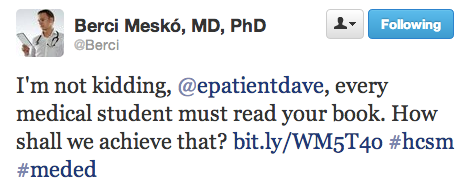
http://scienceroll.com/2013/03/20/let-patients-help-a-new-book-authored-by-e-patient-dave-debronkart/

(Click the image to visit the blog post he linked to.)

Yes, how SHALL we achieve that??  Please, discuss in the comments below!

More about @Berci –

[Read more…]

Filed Under: books 12 Comments

“Let Patients Help”: a patient engagement handbook

Book cover

With Dr. Danny Sands
Introduction by Eric Topol MD

A concise, action-oriented handbook on how to do what medicine calls “patient engagement” – an activated, empowering partnership between patients and their medical professionals.

“I am a better doctor for having read this book. It is clear, concise, and practical. It contains powerful truths that will help both patients and providers (and all the organizations that support them) work together towards what really matters.”

— Laith Bustani, MD, Kingston (Ontario) General Hospital

For more praise, see below.

Where to buy (in eight languages!):

1. English:

  • Amazon (in English; print edition $10 or Kindle $6): Amazon US / UK / France / Deutschland
  • eBook, $6 on Smashwords (ePub for iBook, PDF, Kindle, etc)
  • I can arrange quantity discounts with slower delivery than Amazon. Write to the priority address on the contact page.

2. Spanish (Feb. 2014): “¡Dejad que los pacientes ayuden!”

  • Print edition, on Amazon’s CreateSpace self publishing site
  • Kindle edition, on Amazon


3. Dutch (Nov. 2013):

  • eBook – email for information

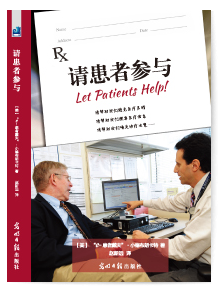
Let Patients Help Chinese cover
4. Greek (Nov 2013): “Οι ασθενείς µπορούν να βοηθήσουν!”

  • Free downloadable PDF (828 kb) on the Patients In Power conference site


5. Hungarian (Jan 2016): “Engedjük a beteget segíteni!”

  • Available on Kindle.


6. German (June 2014): “Lasst Patienten mithelfen”

  • It’s part 1 of the new German textbook “Gesundheit 2.0” (health 2.0) on Amazon.DE


7. French (Nov. 2014): “Impliquons les Patients!”

  • Available on Kindle. Print edition may be available later. 


8. Chinese (2015):
 请患者参与

  • Print edition only. Available for sale only in China.

_________________________

From the book’s sale page:

Concise reasons, tips & methods for making patient engagement effective.

The third book by e-Patient Dave, cancer beater, blogger, internationally known keynote speaker and advocate for patient engagement; co-founder and past co-chair of the Society for Participatory Medicine.

It’s concise – less than 100 pages, takes 60-90 minutes to read – because I want people to READ it all. And DO IT.  And if there’s one thing I’ve learned about medicine in recent years, it’s this rhyme:

Useful advice is often concise.

It’s a book of lists:

  • Part 1: Ten Fundamental Truths
  • Part 2: Ten Ways to Let Patients Help
  • Part 3: Tip Sheets

As the subtitle suggests, this book is about partnership between patients and professionals. It tells why it’s valid and important for medicine to listen to patients, with specific how-to’s on making it a reality. A patient engagement handbook.

In keeping with that spirit, I managed to talk some slick doctors into contributing:

“With Dr. Danny Sands”

My famous primary physician, Dr. Danny Sands, is not only on the cover, he’s in the pages: he wrote some of them. In part 3 (Tip Sheets) he wrote:

  • Ten Things Clinicians Say That Encourage Patient Engagement
  • Ten Things Clinicians Say (or do) That Discourage Patient Engagement
  • For Patients: Collaborating Effectively with Your Clinicians
  • Dr. Danny Sands’ Rules for Smart Web Use

Regular readers will know that Dr. Sands has been a pioneer of patient engagement since the 1990s. Way back then he…

  • co-created the first medical record system and patient portal at our hospital, Beth Israel Deaconess
  • co-authored the first published guidelines on how to do doctor-patient email successfully
  • became a friend and colleague of “Doc Tom” Ferguson, founder of the e-patient movement.

(Why does Danny Sands not have a Wikipedia page??)

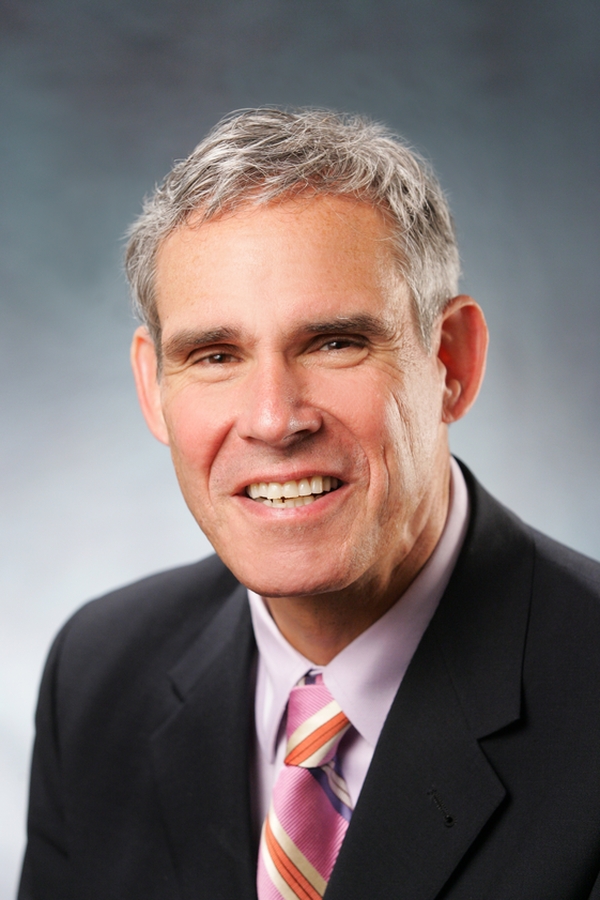
Introduction by Eric J. Topol, M.D.

I’m really thrilled to be honored that the amazing Eric Topol wrote the introduction. Read the full text of it here: “This book will unquestionably help many individuals become more active and fully engaged in their health care.”

If you don’t know Dr. Topol’s name, here are a few glimpses:

  • His excellent January appearance on NBC Rock Center with Brian Williams: The key to better health care may already be in your pocket… and it’s not your wallet
  • His important book Creative Destruction of Medicine
  • His TED talk The Wireless Future of Health. He nailed it – and that was in 2009! (When a visionary like that says this book is right on, I have reason to be thrilled.)

Praise for Let Patients Help!

“I am a better doctor for having read this book. It is clear, concise, and practical. It contains powerful truths that will help both patients and providers (and all the organizations that support them) work together towards what really matters.

“Dave’s story is a testament to the power of people working together to accomplish amazing things against all odds. That’s what we need to do. This is how to start doing it.”

— Laith Bustani, MD, Kingston (Ontario) General Hospital

_____________

“If you’re interested in getting up to speed fast on patient engagement, Let Patients Help is your passport.”

— Susannah Fox, Pew Internet and American Life Project (blog post here)
_____________

“Simply, bravo! … The Ten Fundamental Truths About Health and Care not only confronts the license we all have to be engaged in our own care but also comfortably helps us use it for a collective good.”

–Jim Conway (see blog post), senior quality and safety leader (former senior VP at IHI ; former EVP and COO at Dana Farber Cancer Institute)
_____________

“Will unquestionably help many individuals become more active and fully engaged in their health care.”

From the introduction by Eric J. Topol, MD
_____________

“There’s not a doctor or patient in the land who won’t benefit from reading this clear, concise manual which sets out how each can contribute and collaborate to get better and safer healthcare.”

Dr. Tessa Richards, Analysis Editor, British Medical Journal
_____________

“The culture change that will cure medicine.”

“A must read – a clarion call for the culture change that will cure medicine. If enough people – patients, clinicians, researchers – read this book and act on its wisdom, health and care will be changed, forever, for the better.”

Michael Seid, PhD, Professor, Cincinnati Children’s Hospital Medical Center; Co-Principal Investigator, C3N Project
_____________

“Every medical student must read your book.
How shall we achieve that?”

Bertalan @Berci Meskó, MD, PhD, medical innovator, Webicina.com, author of the award-winning Scienceroll.com
_____________

Questions about the book

  • Why just $8?
    Because I want a gazillion people to buy and read this. I want the decision to be a no-brainer: if you’re at all interested, buy it and read it. And heck, get one for someone else.
  • Volume discounts? I want one for everyone at my conference.
    What, you want discounts off EIGHT BUCKS?? Okay; write to me – dave at epatientdave.com

More questions? Ask in comments below, or email me.

Thank you to everyone who’s supported my work for the past three years, to get to the point where this book is not just possible, but a reality.

March 21, 2013 By e-Patient Dave 4 Comments

“This book will unquestionably help many individuals become more active and fully engaged in their health care.”

As I said yesterday, my new book Let Patients Help is available for sale now. Here’s the introduction, generously contributed by the famed Dr. Eric Topol.

An extraordinary paradox exists in medicine and health care today. On the one hand, as a recent Consumer Reports cover article on cancer tests pointed out “cancer screening remains stuck in a 1960s view of the disease.”[1] This problem of being stuck in our ways is much broader than cancer screening and can certainly be viewed to be operative across the board in health care. On the other hand, we have the newfound potential to obtain unparalleled, critical data and information about each individual. Whether this is via wearable sensors that capture one’s vital signs or sequencing the DNA that comprises one’s genome, we have new tools at our disposal – tools that were not available just a couple of years ago.

The buzzword of “big data” is used to refer to the immense amount of data that is currently being generated throughout the world—more than a zettabyte per year (that is 10,000,000,000,000,000,000,000 bytes). At the same time we can now generate “big data” for each individual and define his or her medical essence. So we have entered an unprecedented time of the information era finally invading and converging with the medical world.

Moreover, this information is flowing in a new way. [Read more…]

Filed Under: books 4 Comments

December 3, 2012 By e-Patient Dave 10 Comments

From now on for me, it’s health *and* care

Health & Care signature

This post became a chapter in my 2013 book Let Patients Help: A Patient Engagement Handbook.

Every year in this season I reflect and renew, emerging in January with new views. This year the first conclusion arrived early: I’m changing a key part of my language. From now on for me it’s not “healthcare,” it’s “health and care.”

Why? Because I’m increasingly seeing that it’s incomplete to look at transforming medicine by just talking about the care part – the part that kicks in when something goes wrong. All of us – patients and providers and insurance and government and industry and everyone – need to be thinking about health, every time we approach a problem with the health care system.

I know I’m not the first to say this, but as a marketing slogans guy (“Let Patients Help,” “gimme my damn data” etc), I’m keenly aware of the power of handy language. Everything I explained above can be said over and over, but it doesn’t fit easily into everyday discourse. “Health and care” is an easy plug-in replacement for the usual “health care.” And that boosts the odds people will use the new wording.

And language defines our thinking.

The implications for patient engagement are clear: it’s not sufficient to get engaged (to get it in gear, to get activated) only when sickness hits. My view from now on is, if you wanna be an e-patient, it starts with holding up your end of the bargain before you get sick.

So for 2013, let’s broaden our scope: the focus of our work should be “health and care.”
__________________

One more thing: I like the  word “care” – it’s patient-centered. In my life getting doctored and nursed, I’ve had the experience of being cared for, and I’ve had the experience of just being treated, without care. When I’m in trouble, what I want – what we should all shop and ask for – is great treatment delivered in a caring way.

Filed Under: books, Health policy, Participatory Medicine, patient engagement 10 Comments

November 28, 2012 By e-Patient Dave 3 Comments

New Hospital Safety Score data: a key enabler for informed choice

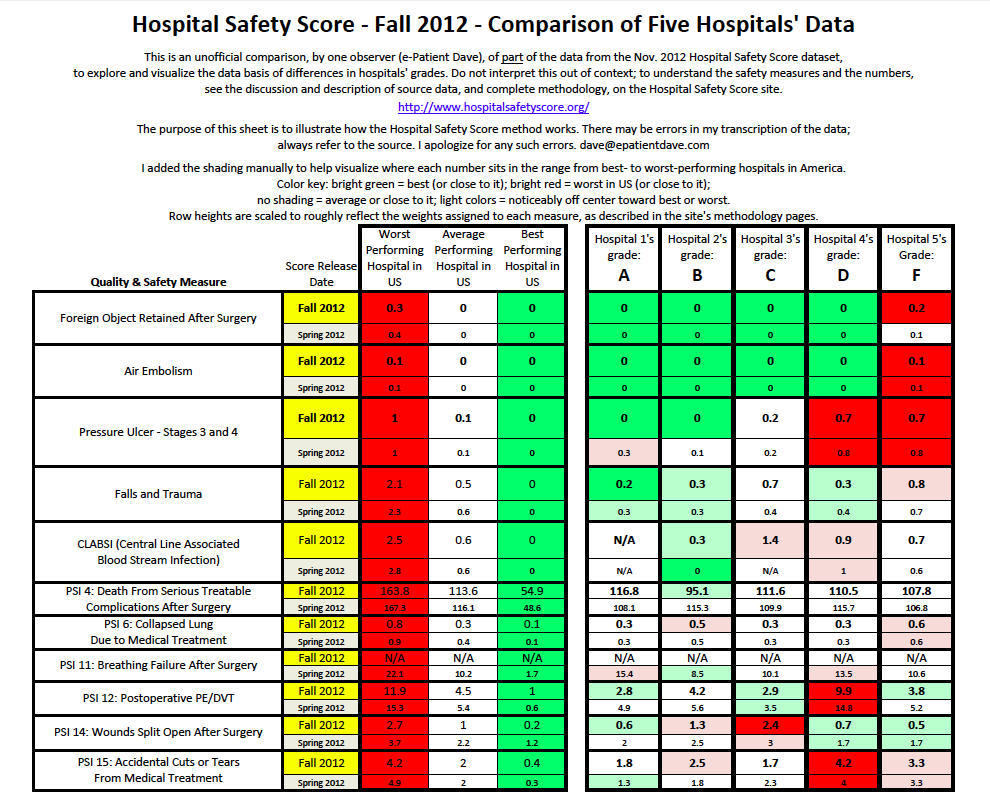
Comparison of five hospitals' data (click to open PDF)
Comparison of five hospitals' data from this report (click to open PDF)

This is cross-posted from e-patients.net.

The PDF at right is a summary of sample data from this new dataset.

The Leapfrog Group is a highly respected patient safety organization. They’ve earned a reputation for carefully and thoughtfully assessing providers’ actual performance in quality and safety. Their mission statement:

To trigger giant leaps forward in the safety, quality and affordability of health care by:

  • Supporting informed healthcare decisions by those who use and pay for health care; and,
  • Promoting high-value health care through incentives and rewards.

Today, Leapfrog’s affiliated organization Hospital Safety Scores announced a major update of its A-through-F grades of thousands of US hospitals, and new smartphone apps to access the data on the fly.

Predictably, the hospitals who got an F – based on their own data! – are saying it’s “not a fair scoring system.” Happily, Leapfrog follows the best practices of open science: they fully disclose all their data, the methodology they used, and who designed the system. This means all buyers of care – e-patients, families, employers – can examine the data and assess claims of fairness for ourselves.

The full press release is here. I won’t take time to go into it; many others are doing so –  here’s a current Google News search and blog search. Here, I want to focus on two aspects that are core to participatory medicine: understanding the data, and why this matters.

[Read more…]

Filed Under: cost cutting edition, decision making, Participatory Medicine 3 Comments

May 21, 2012 By e-Patient Dave 86 Comments

Raw numbers for treating my basal cell carcinoma at three hospitals

The morning-after edits, originally marked in italics, have been “accepted” (to borrow Word’s term) to show the final text.

Here are the results of my cost shopping research to get my skin cancer (basal cell carcinoma, aka BCC) removed. The first edition was done in a hurry because the #bcsm (breast cancer social media) Twitter chat was happening, discussing costs and shopping, and they asked to see it.

It started in February when I decided to be proactive about finding out what this would cost me. I have $10,000 deductible insurance, so this is all coming out of my pocket. In previous months I’d gotten sick & tired of getting unexpected medical bills, and people at the hospital and insurance companies having wrong answers or no answers about “What’s this going to cost?” (CT scan, shingles vaccines)  So, this time I published an RFP (request for proposals), the same way any business would do when making a substantial purchase decision. The RFP started:

Summary: I seek a care partner to remove a basal cell carcinoma (BCC) from my left jawline, under the ear. For a brief introduction, see blog post and photo (low quality) at http://bit.ly/ePDaveBCC.

I’m educating myself about the condition, I want to explore the available treatment options, and I’m “shopping” for a partner to do the work and follow-up with a good combination of quality, partnership, and cost.

It was a crazy thing to do, because hospitals don’t have RFP response departments (as many businesses do), and I was sure my request was largely uninformed. But I sure learned a lot from the comments on that blog post.

[Read more…]

Filed Under: cost cutting edition, decision making 86 Comments

  • « Previous Page
  • 1
  • …
  • 6
  • 7
  • 8
  • 9
  • 10
  • 11
  • Next Page »

Click to learn about Antidote’s clinical trial search engine:

Subscribe by email

Thanks! Check your inbox or spam folder to confirm your subscription.

News coverage

Click to view article


Archives

Copyright © 2025 e-Patient Dave. All rights reserved.