
e-Patient Dave

Power to the Patient!

  • Home
  • Blog
  • Speaker
    • Corporate & associations
    • Healthcare
    • Videos
    • Testimonials
  • Author
  • Advisor
  • Schedule
  • Media
    • Recent coverage
    • News coverage 2010-2014
    • Book mentions
    • Press resources
  • About
    • About Dave
    • Boards & Awards
  • Resources
    • Patient Communities
    • For Patients
    • For Providers
    • Speaker Academy
  • Contact

Search Results for: videos

Videos

My Second Career –
from High Tech Marketing to Healthcare Evangelist
 

Latest additions are at the Blog Posts heading below.
_______

Having survived a medical “death sentence” with the help of brilliant clinicians and treatments, I’m passionate about healthcare – its problems and its potential. Combining that with my experience as a business analyst and conference presenter, I’ve become an avid speaker on all aspects of healthcare transformation, consumerism, digital health (internet-driven “Health 2.0”) and patient experience and engagement. Below are recordings of some of the talks I’ve delivered. From different angles, each weaves in participatory medicine, high-tech thinking in healthcare, social media, patient engagement – and the joy of being alive.

TED Talk: “Let Patients Help”

Over 700,000 subtitles in 27 languages.

Thanks to all the Dutch visionaries who created this extraordinary TEDx Maastricht event on the future of health, especially the team of Lucien Engelen, who had the vision to make a patient the first speaker named, when the event was first announced.  He saw what others are seeing today – the chant at the end of the video: Let Patients Help heal healthcare!

Index of archived presentations

The new era: empowerment and autonomy through AI

Eleven years after that TED Talk, in 2022 generative AI arrived on the scene and changed everything. (I don’t think that’s an overstatement, do you?) Meanwhile, the world has continued to learn how empowerment works. Two recent talks:

  • Returning to the scene of that TED Talk, Maastricht, half a generation later: “Empowerment happens by removing constraints” (May 2024, 19 minutes +Q&A).
  • “The Dawn of Patient Autonomy” – opening keynote at Frontier Health, Berlin, October 2024

Blog posts with videos:

    • NEHIMSS 2019: teaching Patient-Clinical Partnership with role play – and a song, with Dr. Danny Sands (June 2019)
    • HL7 FHIR DevDays 2018: From ‘Let Patients Help’ to ‘Get Out of My Way’: why some patients want ALL their data now, (Nov. 2018)
    • Informal interview with @Chimoose (Greg Matthews) about the business value of the patient’s voice, Oct. 2014 (posted January)
    • From MedicineX 2013: Social Media is a Pipeline of Patient Needs and Perspectives (18 minutes)
    • Digital Health Days, Stockholm (“the Land of Nobel”) (August 2014):
      • 20 Minute Opening Keynote, tying our movement to the history of the Nobel Prize in Medicine
      • 9 minute hallway interview – my views on additional topics at the event, especially Quantified Self, Susannah Fox’s findings on Twitter vs Facebook
      • The closing panel (50 minutes total)
        • My first four minutes start at 18:30, about SPM and Regina Holliday’s story via my “Walking Gallery” jacket
        • Another five minutes start at 33:07, about the potential and the limits of “Gimme My Damn Data”
      • “Dagens Patient” workshop at Karolinska Institute (30 minutes)
    • My Call to Action at the Blue Button Plus Developer Conference, NY (event was July 2013, video was released Feb 2014)
    • AMIA Keynote (standing ovation), Nov. 2013
    • One of my best speeches in years: Keynote Presentation at NEHI’s 2013 Innovation Conference: Patient Engagement 360
    • National Council of State Boards of Nursing, August 2013 (47 minutes)
    • ONC Consumer health IT event, Sept 2013 (14 minutes)
    • SAS Institute, May 2013 (56 minutes)
    • “My Health Counts: e-Patients” (WNED-TV program, 27 minutes; my part’s about 12 minutes)
    • “I want the best to thrive” – keynote to hospital boards and executives, St. Luke’s, Boise ID, Feb 2013 (65 minutes)
    • “Information at the point where it’s needed can save a life” – Joseph H. Kanter Family Foundation (36 minute dinner speech)
  • High Tech: “The Quantified Patient” (The Quantified Self, December 2009; 14:43)
  • Academic / Medical:
    • Doctors and Patients on the Same Page: Welcome to the Age of Participatory Medicine/Open General Session: SIIM (Society for Imaging Informatics in Medicine) (June 2018)
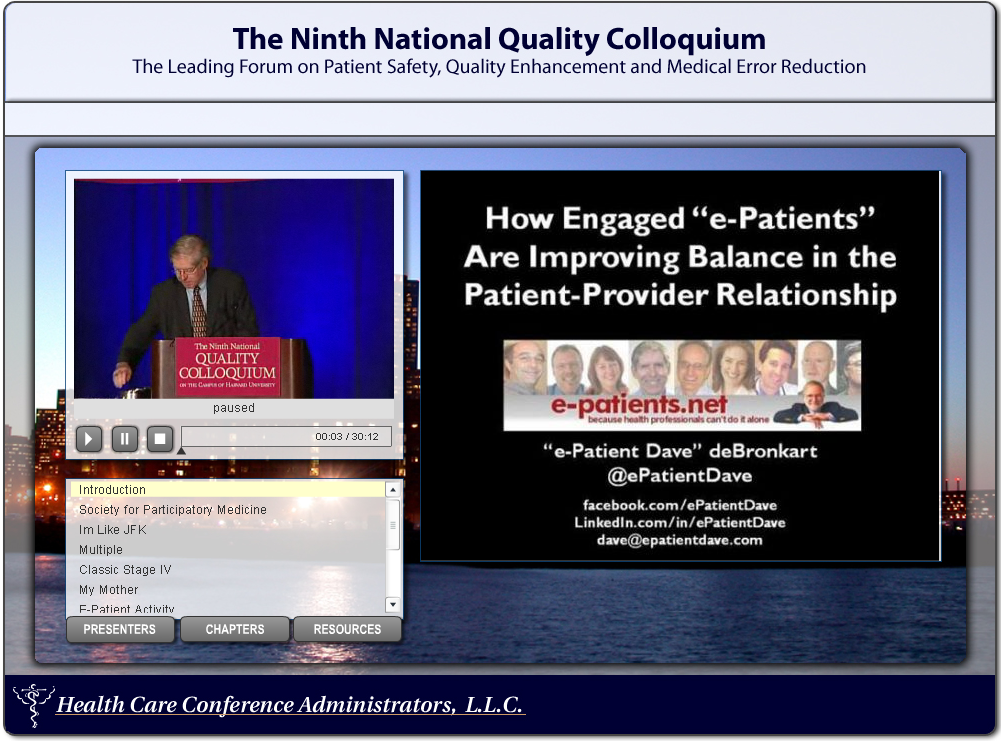
    • “How Engaged e-Patients are Improving Balance in the Patient-Provider Relationship” (Plenary address at Ninth Quality Colloquium, Harvard, August 2010; 30:12)
    • “Gimme My Damn Data” (Opening keynote at Medicine 2.0 Congress, September 2009; 40:00)
    • “How Patient-Provider Engagement Can Transform Healthcare” with Dr. Danny Sands (Special Interest Keynote session A1 at IHI Forum, December 2010; 73:13
  • Business / Social Media:
    • “Are You Ready for the e-Patient?” (Swedish Medical Center, October 2010)
    • “Engage Authentically” (e-Patient Connections, October 2009; 17:50)
  • Policy / Health IT:
    • “Give Us Our Data” (NeHC board meeting, June 2009; 24:06)
    • “Over My Dead Body” (AHRQ IT contractors, June 2010; 1 hour)
  • Impromptu interviews:
    • Reach MD at Alliance for Continuing Education in the Healthcare Professions in Orlando, Florida, Nov. 2017
    • Podcast about clinical trials: Clinical Trials Guru (Sept 2010; 25:59)
    • Dr. Anonymous interview at HIMSS conference (health IT), Atlanta, March 2010

High Tech

Quantified Self, at Wired headquarters: “The Quantified Patient”
December 7, 2009, San Francisco.

“Quantified Self” is an eclectic group that could only exist in the Bay Area – infogeeks who are into measuring just about any aspect of their lives. QS evenings consist of an hour of elbow-rubbing then a series of short, rapid-fire talks; there’s no time to get bored, and you have to get to the point. The challenge here was to deliver a 45 minute talk in 15 minutes, covering all the bases coherently without the usual depth.
Back to top

Business / Social Media

1. Swedish Medical Center: “Are You Ready for the e-Patient?”
October 2010, Seattle.

Swedish, as it’s known, is not known enough. An innovative center of excellence for many years, Swedish celebrated its 100th birthday with a two day conference – and befitting their leadership, they started with a half day social media conference. Earlier in the year, Communications Director Melissa Tizon scored a coup by snapping up social media goddess Dana M. Lewis. Together they put together a terrific line-up of social media stars, talking about all aspects of social media in healthcare. They asked me open the day, challenging employees and visitors to ask whether they’re ready to make the most of working with today’s engaged patients.

(A confession: on this speech I muffed the ending. As you’ll see, uncharacteristically for Seattle, the sun came out and shone straight in my eyes. I usually want a more powerful ending. This one ended where it ended. :–))

2. e-Patient Connections 2009: “Authentic Value: Being Known in e-Patient Communities.”
October 2009, Philadelphia.

The setting was a pharma industry marketing conference, the first to be focused on how industry can engage with activated patients, both to empower patients to have a more active role in their care and, in exchange, so vendors can leverage the sometimes enormous contributions patients can make to the industry’s knowledge. The challenge, of course, is that due to many stories of manipulated data etc etc, many engaged patients don’t trust pharma. I drew on my experience in business and in social media to deliver my message: Engage Authentically.

Back to top

Policy / Health IT


1. National eHealth Collaborative board meeting: “Give Us Our Data
June 24, 2009, Washington.
NeHC is an inspiring collaboration of non-profits in Washington devoted to improving healthcare through technology. This meeting occurred during the pivotal summer discussions about defining the “meaningful use” of health IT that’s required in order to qualify for the incentive payments offered in the ARRA/HITECH stimulus bill of 2009. I was invited to speak on the vital issue of giving patients access to their data.

This was an impromptu talk, which I put together while listening to the previous speakers. It’s an informal recording, not including my slides; it shows my speaking style but not my use of visual aids.

Back to top

2. Keynote to AHRQ’s IT Grantees and Contractors
June 10, 2010

This was the first time I was given a full hour to go deep into my points – not just touch relatively lightly on patient engagement, but dig into why it matters.  The depth matters – that’s why I developed the e-Patient Boot Camp – a full-day workshop. Thank you to Jon White at AHRQ for his partnership both in making this possible and in discussing what would be of value to this audience.

Click below to play the slides. For audio and video, click to download this tiny file, which plays it on AHRQ’s archive. Updated 8/22/15.

About AHRQ: The Agency for Healthcare Research & Quality is a terrific Federal agency that administers grants and contracts for health-related projects, including health IT. This was a high quality audience of smart people who manage significant projects.

About the title: Just before this meeting a rumor was circulating that an executive at a medical records company had said “Over my dead body.” The exec was referring to the idea that these systems would be required to be usable by the clinicians who care for us. I was aghast; a December lecture by Ross Koppel had detailed how bad some of the systems were, and believe me, if hospital staff are caring for my loved one, I want them to have a good system, not one that screws up as badly as Koppel describes. So I threw that line in the industry’s face, using it as my title – and connecting it to why this matters to patients.

We must, must, must stop thinking about systems primarily in technicians’ terms. We must remember that the purpose of healthcare is to deliver care, and tools must support the workers who do that.

Back to top

Academic / Medical

1. “How Engaged e-Patients are Improving Balance in the Patient-Provider Relationship”
(Plenary address at Ninth Quality Colloqium, Harvard, August 2010) Click to visit the video, with slides, on their site. Thanks to the conference for making this video free to the public!
Back to top

2. Opening keynote at Medicine 2.0 Congress: “Gimme My Damn Data”
September 17, 2009, Toronto.

Medicine 2.0 is an academic congress, the only event I’ve attended where every single session was of interest to me in helping learn how Web 2.0 is changing healthcare by newly empowering everyone – not just patients but physicians and researchers. I was humbled to be invited by Dr. Gunther Eysenbach to deliver the opening keynote.

In this expanded 40 minute format I was able to cover not just the cancer story but a broader review of what “e-patient” is about, the opportunity to transform healthcare through participatory medicine and through IT, and the sorry state of affairs we face today regarding patients’ access to their data. (Whose data is it, anyway?) Gimme my damn data, so I can help! The opening slide says September 18 – I got the date wrong!

Part 1:

Part 2:

Part 3:

Part 4:


3. Special interest keynote at Institute for Health Improvement’s 2010 Forum: “How Patient-Provider Engagement Can Transform Healthcare”
December 4, 2010, Orlando.

The Institute for Healthcare Improvement may be the best organization anywhere in the work they do to change the world of healthcare. This year at their annual Forum in Orlando, they did two extraordinary patient-oriented things: they invited fifty patients to attend at no cost, and they put a patient story at the top of the agenda, right after the opening keynote by IHI president Maureen Bisognano.

Dr. Danny Sands and I told our story from both physician and patient perspectives. Thanks to the Institute for Healthcare Improvement for making this video freely available to the public!

Impromptu interviews:

1. Vidcast about clinical trials: Clinical Trials Guru (Sept 2010; 25:59)

These guys are a hoot: with virtually no budget and freely admitting they’re making it up, they’re forging ahead. They do these informal interviews using Ustream, which is not intended for this sort of thing, but it does archive the video, which they can then post like this. They’re advancing their cause using freely available tools, and here we are: they’re reaching you. That’s healthcare social media – one tiny example.

Here’s their archive of past Ustream vidcasts and their clinical trials search page, which pulls from the government website ClinicalTrials.gov. For this series all they do is switch on Ustream (a free videocasting service) and get on the phone with someone. How simple is that? It’s then instantly available for publishing on the web. Here’s our informal, unrehearsed talk:

2. Impromptu interview with “Doctor Anonymous” (March 2010)

He and the famous Doctor Val, both of the Get Better Health blog, were doing scheduled interviews during the huge HIMSS health IT conference in Atlanta. A scheduled guest no-showed, so Val nabbed me in the hall and pulled me in. There was no plan, but we ended up talking about “What the heck is this e-patient stuff, anyway?? Is it about patients thinking they’re smarter than doctors??” No, it’s not – it’s about being good partners with supportive physicians. The interview worked out pretty well – now I’m a guest blogger on their blog!

September 20, 2022 By e-Patient Dave 1 Comment

The Autonomic Nervous System: the Medical Frontier of the 21st Century

In July I gave a virtual talk for Dysautonomia International. Dysautonomia is a family of different conditions, sometimes surprisingly diverse, all related to the autonomic nervous system (ANS). A patient-started and patient-run organization, Dysautonomia International is doing a stupendous job of educating and advocating about this field. The purpose of my talk was to encourage the membership, too, to be proactive in speaking out about how they see things.

The video below is the entire 82 minute closing session of the conference. My talk starts around 24:00, but I encourage you to watch those first minutes, to listen in as patient/founder Lauren Stiles presents what the organization has been doing and introduces this year’s three award winners. This is a great advocacy organization!

[Read more…]

Filed Under: Events Tagged With: dysautonomia, patient communities, pots 1 Comment

Glaucoma

Above: screen captures an earlier version of the animated video below


Latest update, November 15, 2021: This blog post has lots more information on what I’ve learned and what I’m doing about it. The FitEyes community makes clear, once again, that when e-patients get to research their condition and talk to each other, far more information flows than what happens in a typical doctor visit. It’s good!

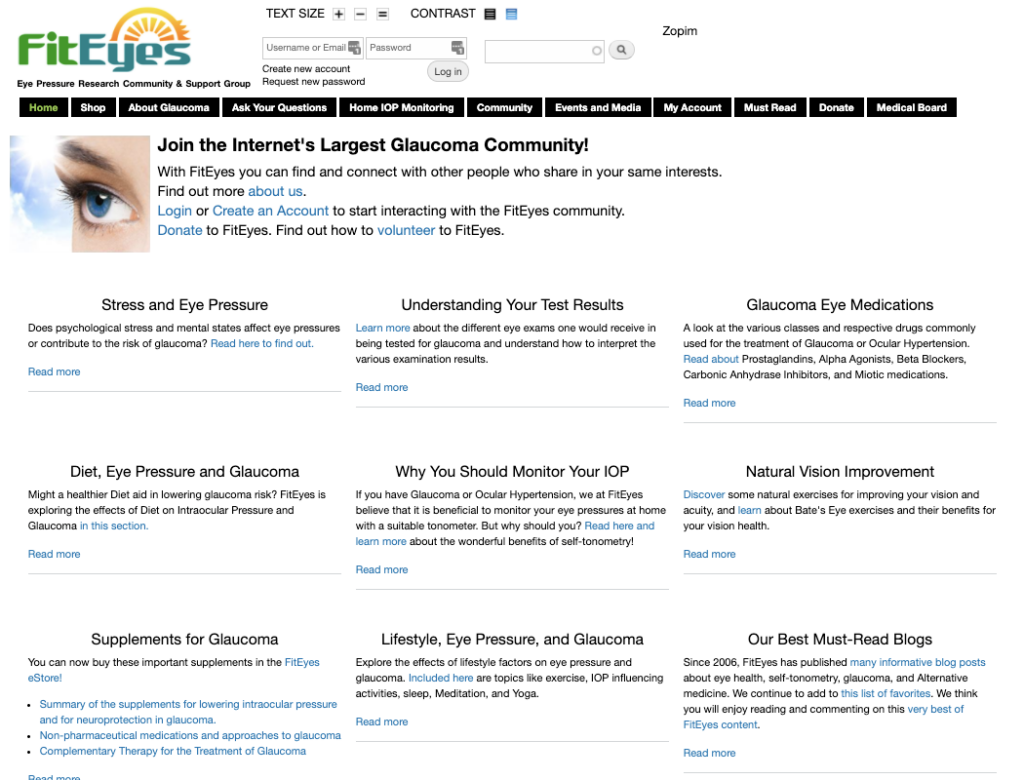
Update November 9: I’m going to stop updating this page because I’ve found exactly the kind of savvy, street-wise patient community I’ve wanted! FitEyes.com, with its companion sites discuss.fiteyes.com (an email group) and a new resource site they’re developing called Ask.FitEyes.com.

See you there – I hope to help further develop what they do into increasingly useful resources for people who are new to glaucoma!


Original text of this page – unfinished notes I gathered early on

Last updated 6/25/21 with new section at bottom on the problems of preservatives in eye drops.


This is not medical advice; it’s my own collection of notes. I’m not a medical authority. You’re welcome to read, but you’re responsible for any decisions you make. I always urge everyone to verify on their own before taking any action, as I always do.

Comments and questions are welcome at bottom of page.

In February 2021 I was diagnosed with glaucoma in my left eye. Glaucoma produces irreversible damage – it’s rather like an amputation (a permanent loss) except you can’t get a replacement “limb.” (Yet.) I’ll use this page as my “outboard memory,” as Susannah Fox puts it – a place to store things so I know where to find them.

Introduction to glaucoma

I’ve been surprised how hard it was to get a good clear introduction to what the disease is. Example: one site said it’s “an increase in intraocular pressure that causes pathologic changes in the optic disk and typical defects in the field of vision.” Huh?? That may be fine for scientists describing things to each other, but it’s useless to a newly diagnosed patient.

Please, experts: empower and inform us, don’t confuse us! We need to know what’s going on in this body, and what can be done about it.

I eventually found this 8 minute series of videos. It’s by far the best overview I’ve found on the nature of the problem and approaches to treatment.

https://share.rendia.com/theater/2a2370ed-4608-4a15-4299-4c144b8a48a3

You can select one part of the series using the “◅◅1/3 ▻▻” counter at bottom left of the player.

The images at top of this page are snapshots from the second of the four parts, which is about the nature of the problem: there’s a pressure build-up in the eye, which kills part of the optic nerve. Kills, as in gone forever.

The four parts of the video:

  1. Your eyesight is important (duh). 57 seconds. You can skip this :)
  2. Excellent animated overview of what the condition is, and approaches to treatment. 1:57
  3. Treatments: various drops, laser surgery, “knife” surgery. 1:50.
  4. Types of tests they use for measuring pressure and parts of the eye

I like the clarity of the sink-and-drain metaphor in the video. But it lacks one important thing: the eyeball isn’t a sink that can overflow. It’s more like a water balloon, where bad things happen if pressure builds up.

How did this happen to me?

Updated March 15: At first I thought it might have been a complication of my botched cataract surgery last summer – I’ll write more about that story later. But glaucoma is strongly hereditary and it hit both my parents; my medical record notes “Fam hx” – shorthand for family history.

Having said that, though, my official diagnosis as of Feb 18 and again March 8 is that it was caused by steroid drops I’d been taking:

Secondary, partial steroid induced glaucoma OS, Moderate Severity

(There’s more on those terms below.)

Important update on mid-summer physician arrogance:

The glaucoma dx came from OCB, the upscale downtown Boston practice where I moved to when I lost confidence in my local practice in Nashua, after I kept having problems.

In August when I returned to the Nashua practice for a separate issue, a senior doctor there (not my regular doc) scornfully said my glaucoma could not possibly have been caused by steroid drops: “It takes MONTHS for that to start happening.” Turns out he’s wrong: more recent research says it can happen in a couple of weeks, which is what happened to me.

NEVER tolerate a doctor who’s arrogant or scornful. They have other priorities – their ego – besides your well-being.

Glaucoma is silent: it’s not normally discovered from pain or visual problems. Indeed, mine was discovered when I sought treatment for an unrelated problem, CME (cystic macular edema). (My Facebook friends can read that story here.)

On Feb 11 I saw a retina specialist at OCB, whose tests led him to promptly mark me as “suspicious for glaucoma” and changed my drops, cutting the steroid drop in half (from 4/day to 2/day) and boosting the NSAID that was intended to balance the steroid drops. On 2/18 I saw a glaucoma specialist at the same practice, who confirmed the diagnosis.

Wherever it came from, I’m stuck with it. So as always the question is, what can I do to strive for the best available outcome? It starts with learning.

Types of glaucoma

As the video above shows, pressure inside the eye is pretty much a matter of plumbing: fluid comes in, and flows out through a drain. Nearly always, nobody notices (did you know your eyes do this??), because it’s balanced and it just works, all through your life.

But there are numerous ways the balance can get thrown off – different types of glaucoma. Here’s is a simplified list. My type is “secondary” – caused by something external, not an internal condition. (Here’s the full list at glaucoma.org)

  • Open angle: by far the most common.
  • Angle closure: this type is a medical emergency, because you could go blind in hours. Something totally cuts off the drain, and pressure builds up quickly, and thus kills the nerve quickly.
  • Secondary – caused by some accident or other external factor. (Here’s the glaucoma.org page on it.) This is the kind I have – glaucoma caused by the steroid drops I was taking four times a day.

About steroid induced glaucoma

This article is pretty lay-friendly. I imagine I’ll want to make a separate web page about this subject, in more depth, but here are some excerpts on the nature of this problem:

  • “caused by increased resistance to the outflow of aqueous at the level of the trabecular meshwork … there is increased production and decreased destruction of the extracellular matrix of the trabecular meshwork.”
    • The “meshwork” mentioned here is the “drain” shown in the video link at top. The eye is constantly getting a fresh supply of aqueous humor, with the old fluid draining out. The drain’s getting clogged because an excess of meshwork tissue is growing and less is wearing away. With the drain clogged, pressure builds up.
  • These “cells have glucocorticoid receptors, and steroids may act on them to alter” how the system works. Aha! So that’s how it happens.
    • It says only 4-6% of the population are “high responders,” having as strong a reaction as I’ve had. Still, that’s about 1 patient in 20, so it seems anytime they put a patient on steroid drops they’d need to monitor them carefully.
  • “Steroid-induced glaucoma is often asymptomatic and detected incidentally by an ophthalmologist.” That’s me.

The damage so far

This ophthalmology practice does OpenNotes – I can see the detailed technical notes the clinicians type into the system. I love it. But although I can see what they wrote, that doesn’t mean it’s understandable. Example from my visit last Monday:

Secondary, partial steroid induced glaucoma OS, Moderate Severity
TMax 37, thin CCT, +Fam Hx
HVF OD ?artifact, OS dense IA
OCT RNFL OD G70, OS 57
Target: < 21 OD, < 16 OS – to be re-evaluated 
IOP 29 at arrival

I won’t explain all of this (yet), but: the left eye’s RNFL (retinal nerve fiber layer) measures 57. Normal is “80-ish.” This means I’ve lost about 30% of the optic nerve in that eye. (The nerves are dead: they’re not coming back. Loss.)

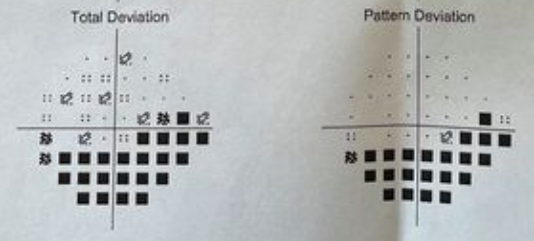
They also gladly printed out the results of my Humphrey Visual Field test (HVF). (This video shows what it’s like to take this test.) These diagrams are both for the left eye. The black squares show where I didn’t detect any test lights: I pretty much don’t see things anymore in the lower part of my left eye … even though my mind thinks I see fine, there. Peripheral vision loss, particularly looking over my left shoulder.

Current plan

As you can imagine, the treatment goal is to bring down the “IOP” – intraocular pressure. Normal range is 10-21. Mine started on 2/11 alarmingly high: 37, or 32 by a different method. (In the note above, “Tmax 37” means 37 is the highest they’ve seen. I don’t know what T stands for.)

Three eyedrops were prescribed. A week later it was down to 26, but this Monday it was back up to 29. Two more drops were prescribed. So I’m using 4 drops twice a day, and another at bedtime.

The info about each drug in this table is from this informative page on glaucoma.org (same place as the video above). Cap color is a big deal when managing a bunch of eyedrops.

Initial meds for the edema (CME):

Both started Jan 20, changed 2/11, tapering off 3/26 to end by 4/9/21

BrandGenericCapFunctionNote
Prolensa

bromfenac

tan

NSAID to reduce edema. $316; not on my insurance.
Prednisolone
(emulsion – shake before using)
pink Corticosteroid. Like all steroids, reduces swelling (edema) by inhibiting immune system..

Glaucoma meds

BrandGenericCapFunctionNote
CosoptDorzolamide / Timolol blueBoth reduce production of fluid.
D: Carbonic Anhydrase Inhibitor
T: Beta blocker.
started 2/11
brimonidinepurple Decreases production of fluid and increases drainage. Alpha adrenergic agonist. started 3/8
Xalatanlatanoprost greenIncreases the outflow of fluid. Use at bedtime. Prostaglandin.started 3/8

Challenges in getting the medicine (in the eyedrops) into the eye

A huge issue, in my view, is that there is zero attention to whether the patient is skilled at getting one drop into the eye. One instruction sheet I saw said “If you’re not sure, squeeze in another one.”

I’ve come to think it’s almost scandalous that the profession doesn’t make a BIG deal of ensuring we patients know how to do eye drops successfully. If we don’t, the medicine doesn’t get into the eye, which is exactly as stupid as if it was hard to know whether you swallowed the right pills. Exactly. But there’s basically no good instruction video.

I’ve been taking eye drops for nine months (since my first, successful cataract surgery) and nobody nobody nobody, anywhere has given me a training session, especially what might go wrong if you’re not careful, causing the prescription to fail.

There’s the challenge of getting the drop (and only one drop) into the eye. Then it turns out there’s a separate problem of making sure the drop stays where it belongs for several minutes so the medicine gets inside. There’s varying advice on that, involving holding your finger on your tear duct to avoid it leaking out. But that’s hard, and the best discussion I’ve seen (the most informed and sensible) about it this on reddit:

“It can also be done by simply closing the eye. It’s equally effective as pushing the tear ducts closed with your finger.”

The discussion there links to this video on glaucoma.org, the site that continues to shine as my most useful source of information. Yet the video shows holding the bottle inches away from your face, which is nuts: for that to work, it better be perfectly straight above, or it’ll splatter on your face. (For that, the best advice I’ve seen was from a Facebook friend: rest the bottle on the bridge of your nose, with the tip over the eye.)


Additional notes to self:

  • The zones of the Humphrey Visual Field test (4:40 video)

Patient communities etc

[Update Nov 9: as noted at top of this page, FitEyes is my new go-to patient group]

  • Reddit r/glaucoma forum – some excellent discussions with science-minded participants and informed, supportive empathy for newcomers. Thank you, Jeanne Pinder!
  • PatientsLikeMe: not much there.
    • glaucoma condition page
    • patient reports on glaucoma meds (very few responses)
    • glaucoma search on Ear, Nose, Throat forum – very little activity, no real community
  • Facebook
    • Glaucoma Support (6.6k members) – good community, sane support
    • Glaucoma support group (3.9k members) – haven’t been there
    • There are 4 others I might try.

Status update 3/27/21

My previous update was 3/11, when the diagnosis got confirmed. On 3/26 the retina specialist did another scan and confirmed that the cyst and the edema are gone. Excellent! So he tapered the CME meds 50% (once a day now) for a final two weeks, which he says ought to reduce the pressure, and with luck maybe the pressure episode will be in the past, and I’ll just be left with one-time damage.

About eye pressure readings

I’ve become highly suspicious of my eye pressure readings. The technology to do this has changed a lot, but I also worry whether these things get checked for calibration.

  • Yesterday 3/25 my left eye measured 25 in Boston, then 4 hours later it measured 18 in New Hampshire.
  • The New Hampshire practice had, the week before, measured that eye with three different devices, getting readings of 8, 11, and 13. (Normal is about 10-21!)
  • In Boston the week before that, it was 29 then 27.

It seems quite unlikely that I’d bounce from 27 down to 13 then back up to 25 in Boston but 18 a few hours later in New Hampshire. I’m going to ask around about this on my patient forums.

Next step: see the glaucoma specialist on April 6.

The problem of preservatives in eye drops

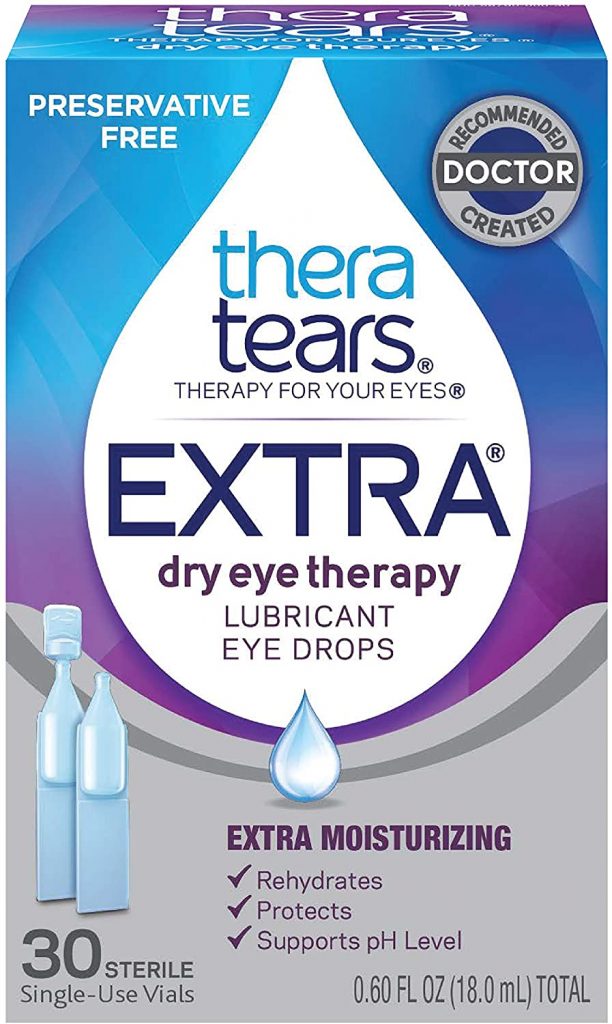
Turns out the surface of my eye is mighty sensitive to the preservatives used in eye drops to keep them from growing bacteria. (Dropping bacteria into the eye is, um, not recommended.) My eyes started to burn, itch, ugh. It turns out this was caused by preservatives: when we switched to preservative-free (“PF”) drops the problem shrank 90% almost overnight. (We did that for 3 of my 4 drops; the other is insanely expensive for PF so I’m using over-the-counter artificial tears (preservative-free Thera-Tears) to soothe them. As of this writing 6/25 I’ve barely needed any for a couple of weeks.

This seems to be an informative article about preservative issues: Preservative-Free Alternatives: Options for decreasing ocular toxicity in patients with glaucoma. Caveat: I haven’t check it yet with any trusted sources, and it’s five years old. Ugh:

Unfortunately, most preservatives in ophthalmic medications disrupt the ocular surface and [aggravate any existing problems with the surface of tye eye, e.g. dry eye.]

Benzalkonium chloride (BAK) is the most widely used preservative in antihypertensive topical medicines, and many studies have clearly demonstrated BAK’s toxic effects on [the surface of the eye].

Arg!

But the article has a priceless quote that shows signs of patient-centered thinking:

Reducing patients’ overall preservative load may improve adherence, [y’think?? if the drops cause pain, I might not take ’em??], quality of life [duh … reducing the itch may improve my quality of life????] and the patient-doctor relationship” [thank you for saying that!]

A big issue with anything PF (prescription or not) is that to keep the drops sealed from contamination, they don’t come in the usual bottle: they come in little plastic “single use” tubes (“vials”). After twisting off the cap and squeezing out one dose, you’re supposed to throw the rest away.

Individual vials cost more, of course. PF TheraTears on Amazon are about 33c/dose; it’s hard to compare unit prices with ordinary bottles, because I can’t find out how many doses you’re supposed to get out of a $13 bottle of drops.

May 7, 2020 By e-Patient Dave 56 Comments

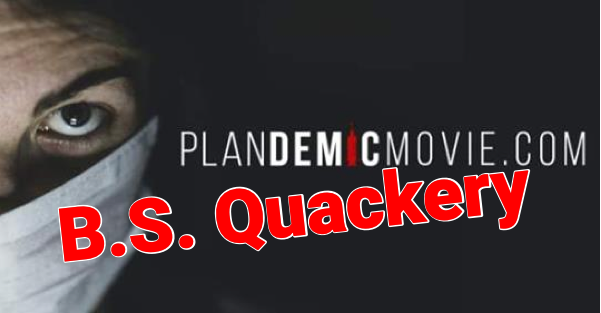
“Plandemic” and Judy Mikovits are COVID-19 conspiracy-theory quackery

Copying this from Facebook last night …

You will soon encounter this recurring antivax / Deep State conspiracy scammer Judy Mikovits, who’s now in a conspiracy movie “Plandemic,” including attacking her long-ago boss Anthony Fauci. The movie ads and promo clips going around are credible-looking well-produced videos full of BS. Don’t fall for it.

[Read more…]

Filed Under: Coronavirus Tagged With: conspiracy theories, coronavirus, covid-19, evidence based medicine, mikovits, quacks, science 56 Comments

March 30, 2020 By e-Patient Dave 1 Comment

Inspiring things people are doing during #StayHome and social distancing

A big part of succeeding against this unknown nasty virus will be not going crazy for however long it takes. And while we have plenty to worry about, life goes on …. and didn’t you just KNOW it would happen?? Amid all the crazy concerns, people are coming up with wonderful contributions to each other and society. Check these out.

1. Father-daughter dance challenge

From Chris Starkey & daughter Brooklyn, in Denver, this appeared last Monday. It has 11 million views in its first week, for good reason. (To hear all the audio you may have to click through and and see it on Facebook.) (Some email subscribers may need to click the headline to see the videos.)

[Read more…]

Filed Under: Coronavirus 1 Comment

October 22, 2019 By e-Patient Dave Leave a Comment

Facebook debate at MCSMN: Links for background and follow-up

The 2019 Mayo Clinic Social Media Network event

Tuesday, Oct. 22, 2019: I’m at the Mayo Clinic Social Media Network’s #MCSMN annual conference, where at 4 pm CT I’ll participate in this debate:

Resolved: Facebook’s disregard for user privacy should compel responsible hospitals to abandon the platform.

[Read more…]

Filed Under: Uncategorized Leave a Comment

  • 1
  • 2
  • 3
  • …
  • 12
  • Next Page »

Click to learn about Antidote’s clinical trial search engine:

Subscribe by email

Thanks! Check your inbox or spam folder to confirm your subscription.

News coverage

Click to view article


Archives

Copyright © 2025 e-Patient Dave. All rights reserved.